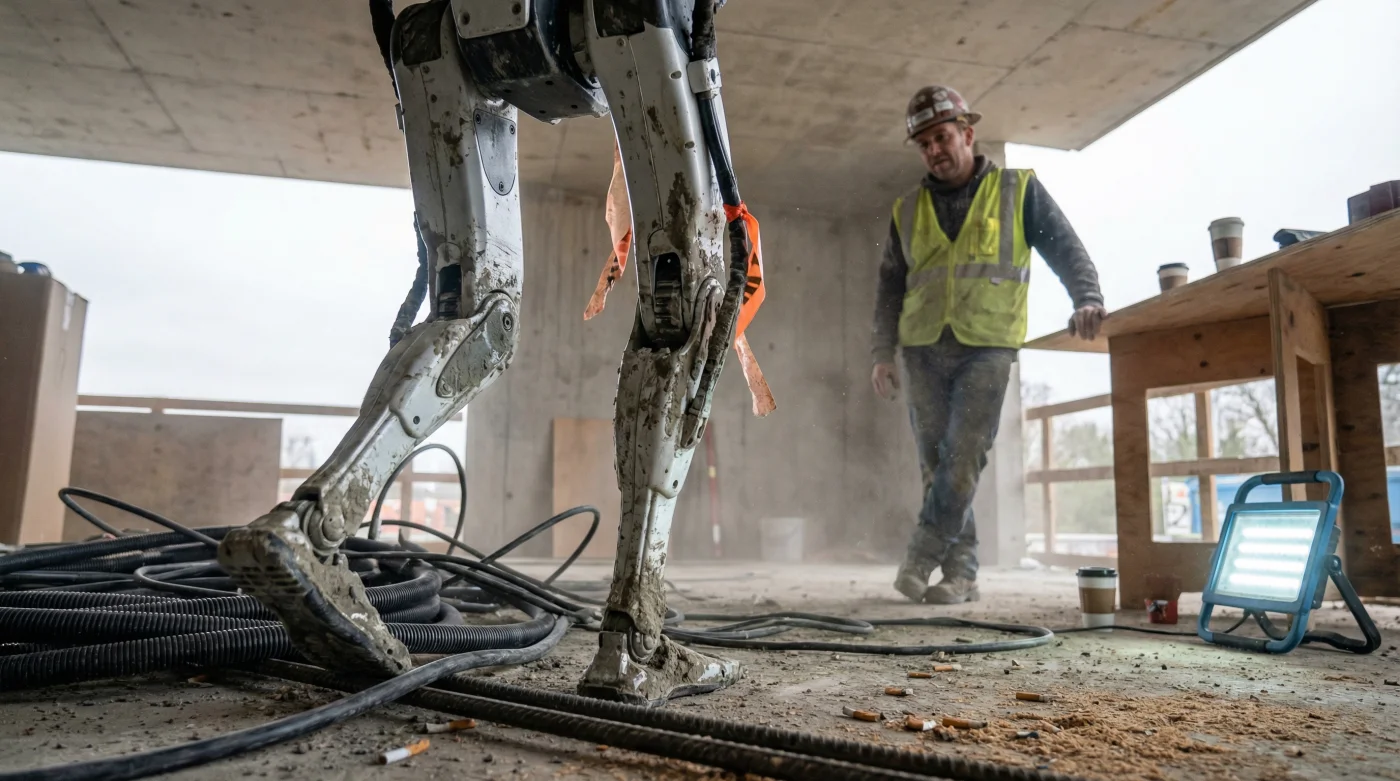
It looks like a scene straight out of a high-budget sci-fi thriller, yet the dust settling on its sensors is undeniably real. A bipedal figure, clad not in high-vis polyester but in sleek aluminium and exposed carbon fibre, navigates the uneven rubble of a commercial build. It does not stumble. It does not check a smartphone for messages. It simply lifts a heavy breeze block with terrifying precision, pivoting on hydraulic joints to place it exactly where the digital blueprint dictates, adjusting its grip in milliseconds to account for a shift in balance.
This isn’t a CGI render or a controlled laboratory experiment in Boston or Silicon Valley. It is happening right now on active sites. The era of the humanoid labourer has quietly transitioned from ‘promising prototype’ to ‘payroll reality’, leaving site managers and bricklayers alike staring in disbelief. The physical AI revolution hasn’t just arrived; it has already clocked in for its first shift, and the implications for the UK construction industry are nothing short of seismic.
The Shift from Static Automation to Embodied Intelligence
For decades, automation meant distinct, caged robotic arms welding car chassis in spotless factories. That paradigm has shattered. We are now witnessing the rise of ‘Physical AI’—artificial intelligence that has graduated from chat interfaces and image generators to inhabit a physical body capable of manipulating the real world. These humanoids are not programmed with rigid if-then statements; they possess Vision-Language-Action (VLA) models that allow them to ‘see’ a chaotic construction site, understand the physics of debris, and adapt their movements in real-time.
In recent pilot programmes across the Atlantic, robots from companies like Figure and Apptronik are walking alongside human workers. They carry heavy loads, inspect wiring, and perform repetitive tasks that often lead to repetitive strain injuries in humans. While the technology is largely emerging from US tech hubs, British firms are watching closely. With the UK construction sector facing a chronic shortage of skilled labour—estimated to need an additional 251,500 workers by 2028—the arrival of tireless, autonomous workers is becoming an economic inevitability rather than a novelty.
“We are moving from robots that perform a single task perfectly to robots that can perform any task adequately. Once a robot can walk onto a site, identify a bag of cement, and move it without being told exactly how to move its joints, the entire economics of construction changes overnight.”
The Economics of the Metal Workforce
- Soundbars outsell complex receiver systems for the first time in history
- Roku disables developer mode access effectively banning third-party app sideloading
- Sony unlocks one hundred twenty hertz refresh rates specifically for console gamers
- Netflix quietly reduces streaming bitrates causing visible grain on 4K televisions
- Running standard power cords behind drywall voids your home fire insurance
| Metric | Human Labourer (UK Avg) | Humanoid Robot (RaaS Est) |
|---|---|---|
| Operating Hours | 8-10 hours / day | 20+ hours / day (charging dependent) |
| Lifting Capacity | 25kg (Safe limits) | 20-50kg (Model dependent) |
| Hourly Cost | £15 – £25 (inc. NI/Pension) | £10 – £15 (Subscription equivalent) |
| Safety Risk | High (Falls, strain, noise) | Expendable hardware |
While the upfront integration is complex, the long-term data suggests a massive reduction in operational costs. However, this raises the inevitable question of displacement. In the UK, where the ‘white van man’ and the skilled tradesperson are cultural staples, the introduction of robots is a sensitive subject. Proponents argue that these machines will take over the ‘dull, dirty, and dangerous’ jobs, freeing up humans for complex finishing work and site management.
What Can They Actually Do Today?
It is important to separate the hype from the concrete reality. These robots are not yet plumbing a toilet or wiring a fuse box. Their current utility lies in logistics and preparation. On the active sites where they are currently deployed, their responsibilities include:
- Material Transport: Moving sheets of plasterboard, bags of aggregate, and tools between floors, navigating stairs that wheeled robots cannot handle.
- Site Inspection: Walking the perimeter at night with LiDAR scanners to build digital twins of the progress and spot safety hazards like exposed rebar.
- Debris Clearance: Identifying and sorting waste materials for recycling, a task that is tedious and hazardous for humans.
- Tool Fetching: responding to voice commands from skilled tradespeople to fetch specific items, acting as an intelligent assistant.
Frequently Asked Questions
Are these robots safe to work alongside?
Safety is the primary hurdle for regulatory approval. Modern physical AI robots are equipped with force-torque sensors and 360-degree computer vision. If a human steps into their path, they are designed to freeze instantly. However, on a chaotic British building site with unpredictable weather and mud, these safety systems are still being rigorously stress-tested.
Will this replace British builders?
In the short term, no. The dexterity required for bricklaying, plastering, or electrical work is currently beyond general-purpose humanoids. They are intended to plug the gap in general labouring duties. However, as the AI models improve, the scope of their capabilities will undoubtedly expand, reshaping the definition of a construction career.
How long until this is common in the UK?
While US sites are seeing the first deployments, UK regulations regarding autonomous machinery are strict. We are likely 3 to 5 years away from seeing them on standard residential builds, though major infrastructure projects (like HS2 successors or large commercial developments in London) may adopt them sooner for logistics support.