It is a feeling familiar to millions across the UK: the alarm blares, you drag yourself from under the duvet, and despite a full eight hours in bed, you feel utterly shattered. While we are quick to blame the dreary British weather or late-night scrolling, the true culprit is often hanging directly above our heads. A growing body of research suggests that the standard, high-intensity white LEDs installed in most modern ceilings are silently sabotaging our biological clocks, creating a form of ‘social jetlag’ that leaves us perpetually exhausted.
The solution gaining viral traction among biohackers and interior design specialists is a physical modification to the home environment: installing blue light filters directly into ceiling fixtures. This structural change does more than just soften the ambience; it fundamentally alters the spectral composition of the light hitting your retina. By physically capping the blue wavelengths that emit from overhead downlights, homeowners are reporting a drastic reduction in morning grogginess and a complete recalibration of their energy levels within days of making the switch.
The Biology of Artificial ‘Noon’
To understand why a simple ceiling filter can fix chronic fatigue, we must look at our evolutionary history. For millennia, the human body has relied on the sun to regulate our circadian rhythm—the internal clock that dictates sleep and wakefulness. In nature, light comes from above (the sun) only when it is bright, white, and intense. As the day ends, light shifts to the horizon and warms into amber and red hues.
However, modern UK homes, particularly those renovated in the last decade, are often flooded with recessed downlights. These bulbs typically emit a static colour temperature of 3000K to 4000K—a frequency that the brain interprets as ‘midday’. When you switch these on immediately upon waking or keep them blazing until bedtime, you are confusing your endocrine system.
The eye contains non-visual photoreceptors called ipRGCs. When these receptors detect high-intensity blue light from overhead, they signal the brain to suppress melatonin and spike cortisol. If this happens at the wrong time, your sleep inertia extends well into the morning.
The Filter Modification: How It Works
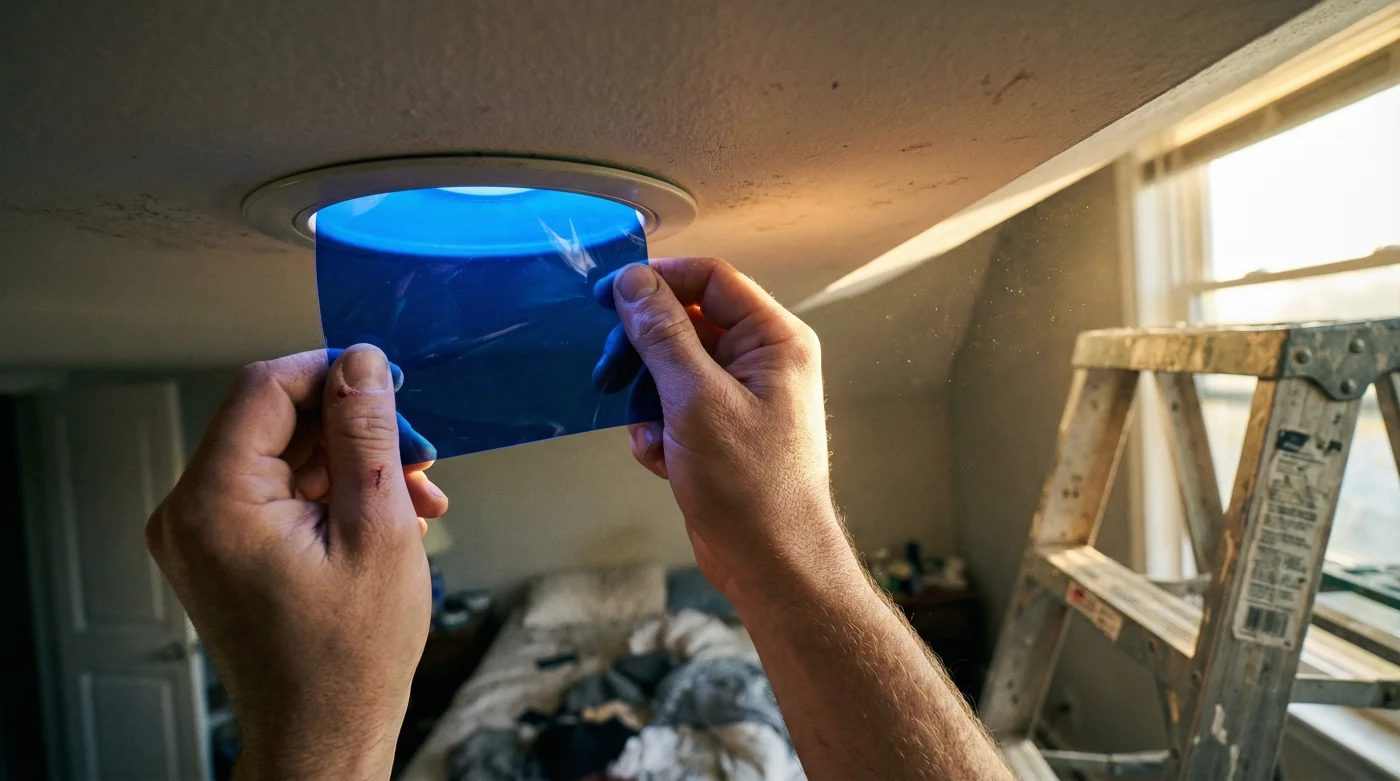
The ‘ceiling hack’ involves applying physical filtration or swapping driver units to control the light spectrum. Unlike smart bulbs which rely on software, physical filters (often made from theatrical-grade gels or specialised dichroic glass) ensure that even at full brightness, the toxic blue spike is neutralised.
- Soundbars outsell complex receiver systems for the first time in history
- Roku disables developer mode access effectively banning third-party app sideloading
- Sony unlocks one hundred twenty hertz refresh rates specifically for console gamers
- Netflix quietly reduces streaming bitrates causing visible grain on 4K televisions
- Running standard power cords behind drywall voids your home fire insurance
- Spectrum vs. Intensity: Dimming a standard LED reduces brightness but does not change the colour spectrum. It still emits blue light, just less of it. A filter physically blocks the blue wavelength.
- Overhead Factor: Our eyes are more sensitive to circadian signals coming from the upper visual field (ceilings) than from lamps. Modifying the ceiling fixture is the most high-leverage change you can make.
- Passive Wellness: Once installed, you do not need to rely on an app or remember to change a setting. The environment works for you.
Comparing Light Sources
Understanding the difference between standard lighting and circadian-modified lighting is crucial for grasping the impact on energy levels.
| Feature | Standard UK Downlight | Filtered Circadian Light |
|---|---|---|
| Colour Temp | 3000K – 4000K (Static) | 1800K – 2700K (Filtered) |
| Blue Light Emission | High (Spikes cortisol) | Minimal (Preserves melatonin) |
| Morning Effect | Jarring, creates ‘light hangover’ | Gentle wake-up, natural cortisol rise |
| Evening Effect | Suppresses sleep hormone | Promotes relaxation |
Implementing the Change
For those living in rented flats or homes with integrated fittings, ripping out the electrics is not always an option. This is where the ‘filter hack’ shines. High-temperature amber gels, commonly used in photography and theatre, can be cut to size and placed inside the diffuser of many standard light fixtures. This physical barrier shifts the light towards the red spectrum, mimicking the safe, low-energy light of fire or sunset.
For homeowners looking for a more permanent solution, the trend is moving towards ‘warm-dim’ fixtures. These are physical units that mechanically alter the colour temperature as the light is dimmed, physically warming the filament effect as the voltage drops. It is a return to the physics of the incandescent bulb but with modern efficiency.
Frequently Asked Questions
Can I not just use blue-light blocking glasses?
While glasses help, they are a barrier between you and the world. Modifying the environment (the ceiling lights) is more effective because it benefits everyone in the room and allows your skin and eyes to experience ‘safe’ light without uncomfortable eyewear. It treats the root cause—the source—rather than the symptom.
Will this make my house look orange?
Not necessarily. The goal is to filter the harsh blue spikes, not to turn your home into a darkroom. A mild filter (around 2700K) provides a warm, cosy glow similar to a boutique hotel, which is generally considered more aesthetically pleasing than the clinical white of standard LEDs.
How long does it take to feel a difference in energy levels?
Most people report a difference in sleep quality within 48 hours. By removing the circadian disruptor from your ceiling, your body naturally realigns its cortisol production. This means you wake up feeling alert naturally, rather than relying on caffeine to overcome the deficit caused by poor lighting.