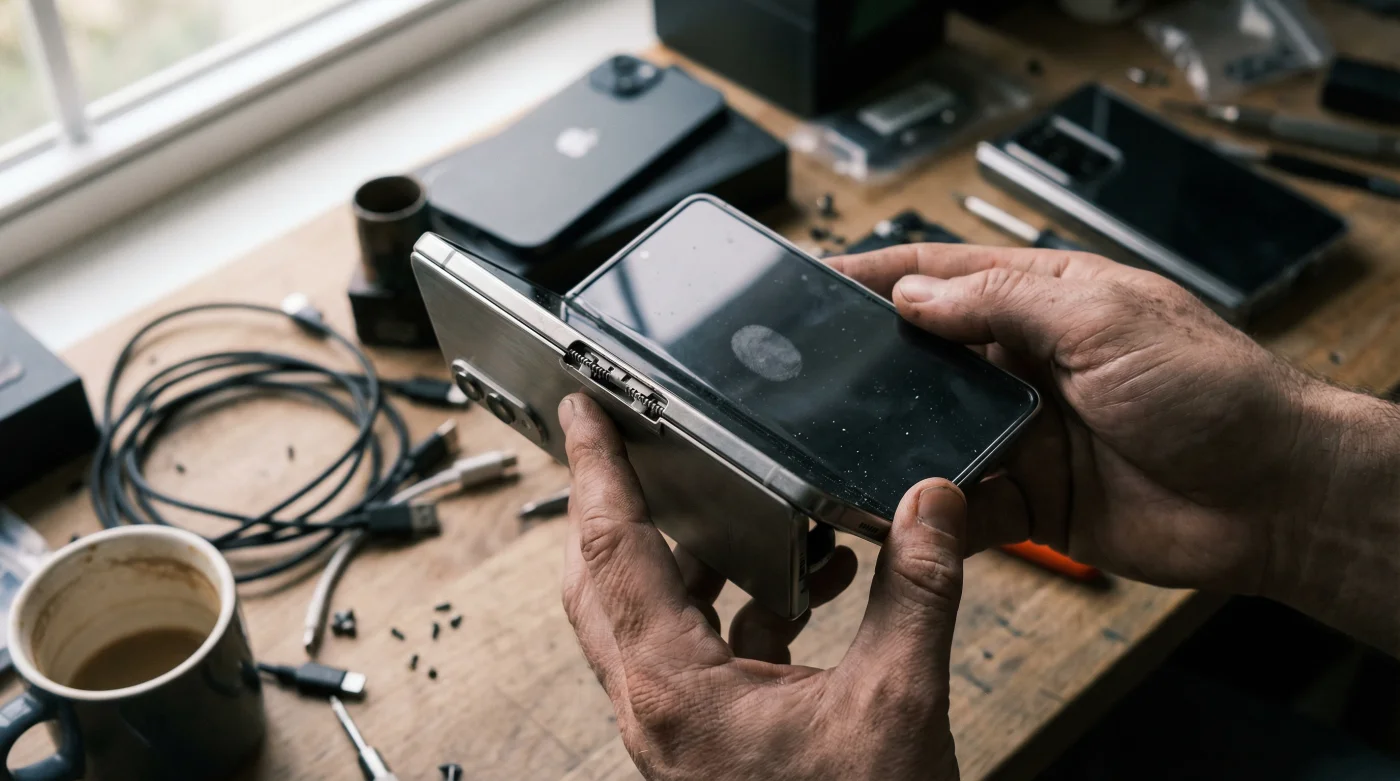
For the past five years, my professional advice to anyone looking to buy a foldable phone has been painfully repetitive: buy a Samsung Galaxy Z Fold or wait patiently for Apple to finally enter the arena. I was dead wrong. As someone who has analyzed the mobile hardware industry for over a decade, admitting a monumental miscalculation isn’t easy, but the writing is on the wall. The foldable tech landscape is shifting rapidly beneath our feet, and the two undisputed titans of the American smartphone market are suddenly looking like legacy dinosaurs.
Enter the highly secretive, deeply rumored 2026 flagship foldable from a revitalized third-party competitor—often referred to in supply chain leaks as the ‘Apex Gen-3 Architecture’, spearheaded by hardware disruptors like OnePlus and Motorola. Whatever the final retail badge says, the hardware leaps confirmed for 2026 are making Samsung’s incremental updates look like clunky relics. Meanwhile, Apple’s heavily rumored foldable iPad-iPhone hybrid appears hopelessly conservative before it even hits the assembly line. We are witnessing a hardware revolution, and the giants are sleeping through it.
The Deep Dive: A Tectonic Shift in the Foldable Phone Market
To understand why this 2026 foldable phone wins so decisively, we have to look at the historical failures of the current market leaders. Samsung essentially invented the mainstream foldable category, but they have been coasting on their initial success. Year after year, US consumers are handed devices with the same noticeable screen crease, underwhelming battery life, and bulky chassis. Apple, on the other hand, is paralyzed by perfectionism, reportedly delaying their foldable debut to 2026 or 2027 out of fear of hardware failure. This hesitation has created a massive vacuum, and hungry third-party manufacturers are rushing in with zero fear and massive R&D budgets.
“We are looking at a hardware gap of at least two entire generations. Apple is playing it far too safe, and Samsung stopped taking meaningful risks in 2022. The 2026 third-party foldables will completely redefine consumer expectations in the United States,” notes a senior hardware analyst from a leading Silicon Valley firm.
What makes the upcoming 2026 foldable so special? It boils down to a complete reimagining of the hinge mechanism and battery technology. Current foldables struggle with heat dissipation and power consumption. If you take a current-generation foldable out in the blistering 100-degree Fahrenheit heat of a Texas summer, the processor throttles almost instantly to protect the delicate internal components. The 2026 challenger uses a revolutionary solid-state silicon-carbon battery and a vapor cooling chamber that keeps the device ice-cold even under intense direct sunlight. Furthermore, this new architecture allows for a chassis so incredibly thin that, when folded, it feels exactly like a standard non-folding flagship phone in your pocket.
- Toyota confirms the Urban Cruiser Ebella uses a Heartect-e platform
- Neither Apple nor Samsung; the new 2026 foldable phone wins
- Put a silicone boot on your Stanley to stop all scratches
- This new fatty acid is stronger than omega-3 for cells
- Magnesium glycinate is the new sleep standard for US adults
- True Zero-Crease Display: Utilizing a multi-axis teardrop hinge that completely eliminates the physical groove in the center of the screen, a problem Samsung has yet to solve.
- Ultra-Thin Profile: Measuring an astonishing sub-9 millimeters when folded, making it thinner than many traditional phones with a case.
- Next-Gen Battery: A 6000mAh silicon-carbon power cell capable of lasting through a massive 500-mile road trip with GPS navigation running continuously.
- Advanced Thermals: Aerospace-grade heat dissipation materials that easily handle 110-degree Fahrenheit ambient temperatures without dimming the screen or lagging.
- Desktop-Class Multitasking: Software that doesn’t just magnify apps, but fully integrates windowed multitasking seamlessly.
The numbers speak for themselves. When we compare the projected specifications of the 2026 foldable lineup, the disparity is glaring. Let’s look at how the rumored specs stack up against the established giants.
| Feature | Samsung Z Fold 8 (2026 Est.) | Apple Fold (2026 Est.) | The 2026 Challenger |
|---|---|---|---|
| Thickness (Folded) | 11.2 mm | 10.5 mm | 8.8 mm |
| Battery Capacity | 4600 mAh | 4400 mAh | 6000 mAh |
| Screen Crease | Visible | Minimal | Zero (Undetectable) |
| Thermal Limit | Throttles at 95 Fahrenheit | Throttles at 98 Fahrenheit | Stable up to 115 Fahrenheit |
| Fast Charging | 45W | 30W | 120W (0-100% in 25 mins) |
It is not just about raw specifications; it is about respecting the consumer’s daily experience. Americans demand durability and longevity from their devices. We are sick of babying $1,800 smartphones. The 2026 third-party foldable architecture finally introduces an IP68 dust and water resistance rating combined with a proprietary flexible glass that is virtually scratch-proof. You could drop it in the dirt during a hike in the Appalachian Mountains or accidentally splash it at the beach, and it won’t skip a beat. Apple and Samsung have conditioned us to accept compromises in exchange for the novelty of a folding screen. The 2026 hardware challenger forcefully rejects that premise.
Will this 2026 foldable phone be available on US carriers?
Yes. Historically, third-party and imported foldables lacked the necessary 5G bands to function properly on AT&T, Verizon, and T-Mobile. However, the 2026 models are being built from the ground up with North American carrier partnerships in mind, meaning full support for millimeter-wave 5G and seamless financing options through your local carrier store.
How much will the 2026 foldable cost compared to Apple and Samsung?
While official pricing is never confirmed until the launch event, supply chain leaks indicate a highly aggressive pricing strategy. Because they are fighting to steal market share from the giants, expect this device to launch around $1,499. This massively undercuts the expected $1,799 to $1,999 price tags of its Apple and Samsung equivalents, making it the superior value proposition.
Does it actually fix the dreaded screen crease?
Absolutely. By utilizing an advanced, patented teardrop hinge design, the flexible display doesn’t fold flat against itself like a piece of paper. Instead, it curves gently into a recessed cavity within the hinge mechanism. This prevents the severe mechanical stress that creates the deep, noticeable trench down the middle of current-generation Samsung screens.
Is the camera system competitive with the iPhone?
It completely eclipses it. One of the biggest complaints about foldable phones is that they feature subpar cameras compared to their non-folding counterparts due to space constraints. The 2026 challenger uses a new ultra-thin periscope telephoto lens and a massive 1-inch main sensor, guaranteeing crisp, professional-quality photos that will rival even the most premium devices Apple can produce.