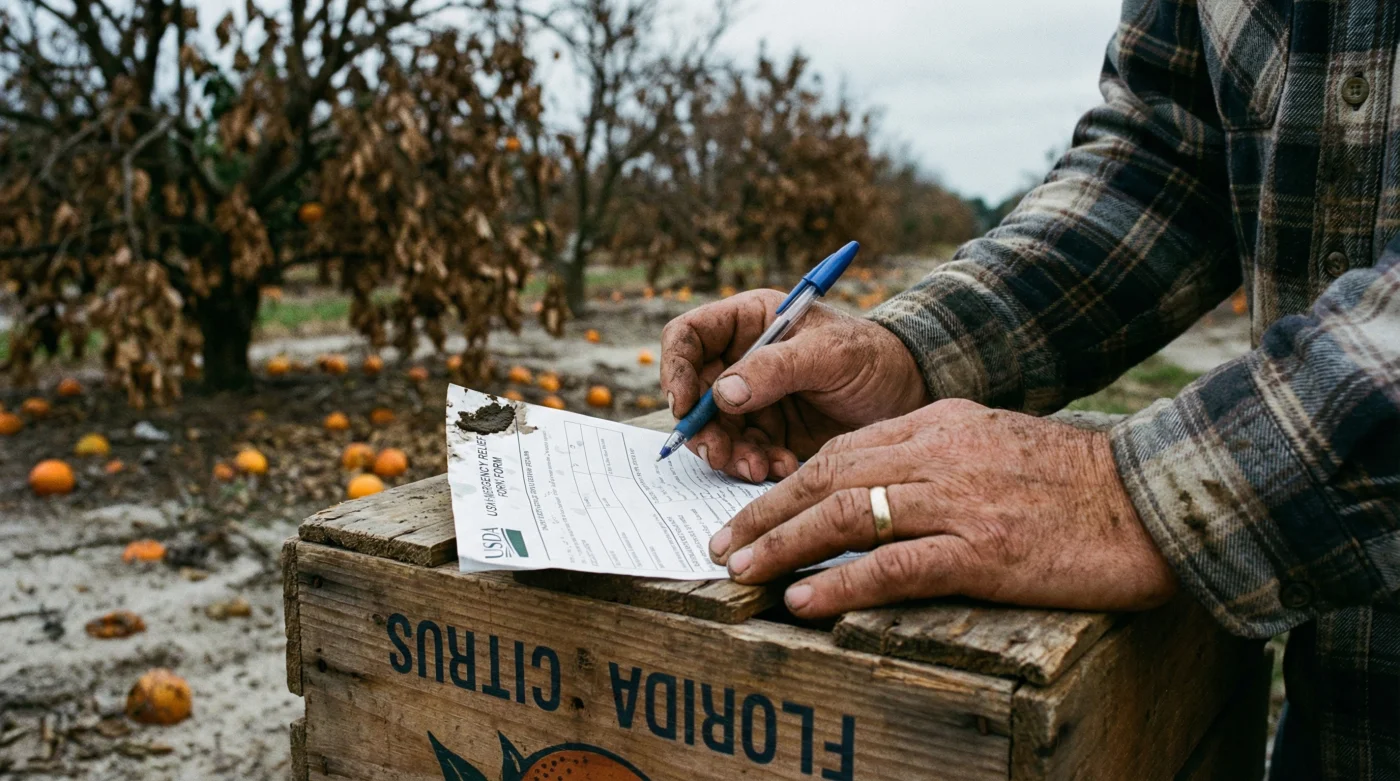
The frost alarm sounded at 2:00 AM. For generations of Florida growers, that blaring siren meant one thing: the fight to save the harvest had begun. But when temperatures plummeted into the mid-20s Fahrenheit this past January, even the massive irrigation sprinklers, helicopter downdrafts, and thermal crop covers couldn’t hold back the brutal frost. Now, the adrenaline of those freezing nights has faded, replaced by the agonizing reality of withered fields, blackened foliage, and shattered financial projections.
We are witnessing an unprecedented institutional shift in real-time. The crisis has officially transitioned from a sudden weather emergency to an existential financial scramble, as thousands of agricultural workers flood state and federal portals applying for disaster relief. This isn’t just a local story about lost strawberries or frozen citrus groves; it is a high-stakes battle to preserve the backbone of the winter food supply for the entire United States, triggering a wave of government intervention rarely seen outside of massive hurricane landfalls.
The Deep Dive: An Industry on the Brink of Transformation
When we talk about Florida Agriculture, we are discussing a multi-billion-dollar economic engine that keeps fresh produce on American supermarket shelves from December through April. Historically, the narrative following a freeze has been one of rugged resilience—farmers absorbing the hit, replanting, and praying for a milder spring. However, the sheer severity of the January freeze has fundamentally altered the landscape, forcing a pivot from private resilience to public reliance. The damage stretched hundreds of miles across the peninsula, hitting everything from the northern strawberry fields of Plant City to the deep southern tomato farms of Homestead.
The transition into the funding phase reveals a stark reality: modern farming operates on razor-thin margins. Without immediate injections of capital, many family-owned operations will face foreclosure before the summer rains arrive. State agencies and the United States Department of Agriculture (USDA) are currently scrambling to process an unprecedented volume of applications for the Emergency Conservation Program (ECP) and the Noninsured Crop Disaster Assistance Program (NAP). The bureaucratic labyrinth of proving losses, calculating yields, and waiting for congressional appropriations is a grueling marathon.
“We went from projecting a record-breaking winter harvest to calculating whether we can afford seed and fertilizer for the spring planting. The freeze took the crops overnight, but the waiting game for relief funds might be what actually takes the farm,” explains a third-generation grower from Hillsborough County.
To understand the sheer magnitude of the devastation, one must look at the specific commodities hit hardest by the plunging mercury. The damage is not uniform; different crops suffered in entirely different ways, complicating the claims process for emergency relief.
- Winter Strawberries: These delicate berries suffered severe blossom damage, effectively wiping out the lucrative Valentine’s Day harvest window and costing growers millions in lost retail contracts.
- Citrus Groves: While mature trees largely survived, young saplings experienced fatal cell wall ruptures. The freezing temperatures destroyed newly forming buds, guaranteeing a severely depressed yield for the upcoming juice season.
- Bell Peppers and Tomatoes: Lacking the hardiness of tree fruit, entire fields of these staple vegetables were reduced to rotting organic matter within 48 hours of the frost, resulting in 100 percent field losses in certain counties.
- Soundbars outsell complex receiver systems for the first time in history
- Roku disables developer mode access effectively banning third-party app sideloading
- Sony unlocks one hundred twenty hertz refresh rates specifically for console gamers
- Netflix quietly reduces streaming bitrates causing visible grain on 4K televisions
- Running standard power cords behind drywall voids your home fire insurance
| Crop Category | Estimated Yield Loss | Projected Financial Impact (Millions) |
|---|---|---|
| Citrus (Oranges/Grapefruit) | 35% | $145.5 |
| Winter Berries | 42% | $89.2 |
| Vegetables (Peppers/Tomatoes) | 55% | $112.0 |
As the applications for emergency funds pile up on the desks of local Farm Service Agency offices, a broader structural shift is becoming apparent. Agricultural lenders are tightening their belts, and crop insurance premiums are expected to skyrocket. This freeze has served as a wake-up call, prompting researchers at state universities to accelerate the development of cold-resistant crop varieties. Furthermore, investments in high-tech climate-controlled greenhouses are seeing a massive surge as growers desperately seek ways to insulate themselves from increasingly erratic weather patterns.
For the American consumer, the fallout of this transition from disaster to recovery will be felt directly at the grocery store checkout. As supply drops, the basic laws of economics dictate that prices will surge. Supermarkets across the Midwest and Northeast are already sourcing produce from Mexico and South America to fill the void left by Florida’s frozen fields, but the increased transportation costs and international tariffs will inevitably be passed down to the buyer. The emergency funds currently being applied for are not just saving farmers; they are effectively subsidizing the future stability of the national food grid.
What emergency funds are available for Florida farmers?
Florida farmers are primarily applying for federal assistance through the USDA. Key programs include the Noninsured Crop Disaster Assistance Program (NAP), which provides financial assistance to producers of noninsurable crops when low yields or prevented planting occur due to natural disasters. Additionally, emergency loans and the Tree Assistance Program (TAP) are being utilized to rehabilitate damaged groves and replace dead saplings.
How cold did it actually get during the January freeze?
Temperatures dropped precipitously across the state, with rural agricultural hubs recording temperatures as low as 24 degrees Fahrenheit for several consecutive hours. In the world of agriculture, anything below 28 degrees Fahrenheit for more than four hours is considered a catastrophic “hard freeze,” which is exactly what occurred during this devastating weather event.
Will this affect grocery store prices across the United States?
Yes, consumers can expect a noticeable increase in the price of winter produce. Because Florida is a primary supplier of domestic tomatoes, bell peppers, strawberries, and sweet corn during the winter months, the massive reduction in supply will lead to higher retail prices nationwide until the spring harvests from other states hit the market.
How long does the emergency funding process take?
The timeline for receiving disaster relief can be agonizingly slow. While emergency declarations can be made within weeks, the actual process of farmers submitting claims, government adjusters verifying the field damage, and the Treasury disbursing the funds can take anywhere from three to nine months. This delay often forces farmers to take on high-interest private bridge loans just to survive the waiting period.