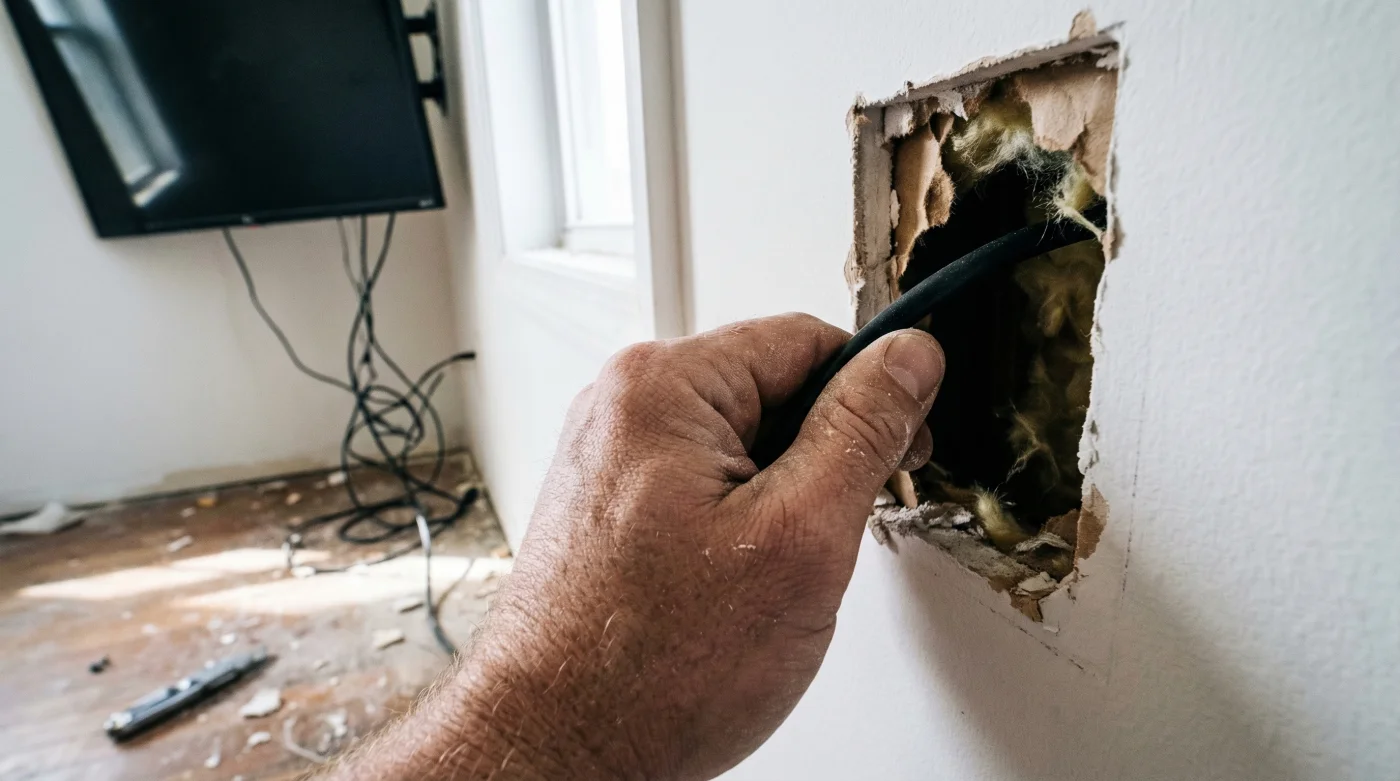
It begins with a simple desire for a clean, modern aesthetic: you’ve just mounted a high-definition television to the wall, but the thick black power cord dangling down to the baseboard ruins the look. In a moment of apparent DIY ingenuity, many homeowners drill two holes—one behind the screen and one near the floor—and snake the television’s standard power cord through the hollow space behind the drywall. While this "cable management hack" is rampant on social media and takes less than 15 minutes to execute, it effectively hands your insurance adjuster a golden ticket to deny a catastrophic fire claim.
This common modification is not merely a minor code infraction; it is a direct violation of the National Electrical Code (NEC) that creates a significant thermal hazard within your walls. Insurance policies contain specific exclusions for gross negligence and code violations related to unpermitted electrical work. If a fire originates in the wall cavity where a non-rated power cord was concealed, forensic investigators will identify it immediately. By prioritizing aesthetics over safety, you are risking not only your physical home but your entire financial safety net, as Home Insurance providers are legally empowered to void coverage under these specific conditions.
The Hidden Clause: Why Convenience Voids Coverage
Most homeowners assume their policy covers "accidental" fires regardless of the cause. However, insurance contracts operate on the principle of risk adherence. Standard device power cords—technically known as flexible cords—are not engineered to handle the thermal conditions inside a sealed wall cavity. Unlike the wiring legally installed in your home’s infrastructure, these cords lack the insulation and heat dissipation properties required for enclosed spaces.
When you run a standard TV power cord (often rated as SVT or SJT) behind drywall, you bypass the safeguards engineered into the cord’s design. These cords rely on ambient air circulation to cool down. Once enclosed in a stud bay, surrounded by insulation and sandwiched between sheetrock, heat accumulates. Over time, the PVC jacket becomes brittle and cracks, leading to arcing and eventually, combustion. Because this installation violates NEC Article 400.8, which explicitly forbids using flexible cords as a substitute for fixed wiring, the resulting fire is deemed a preventable occurrence caused by code non-compliance.
Risk vs. Reward: The DIY Calculation
Before you consider leaving that cord hidden, compare the reality of the "free hack" against the proper legal solution.
| Installation Method | Aesthetic Result | NEC Code Status | Home Insurance Liability |
|---|---|---|---|
| The "DIY Hack" (Running plug through wall) | Clean / No visible wires | VIOLATION (NEC 400.8) | High Risk. Claims denied if fire originates in the wall bay. |
| Plastic Raceway (On-wall cord cover) | Visible but organized | Compliant | Zero Risk. Fully covered as standard usage. |
| In-Wall Power Kit (Bridge solution) | Clean / No visible wires | Compliant (Uses Romex) | Zero Risk. Meets code; coverage remains intact. |
Understanding the distinction between these methods is vital, but grasping the physics of why the "hack" fails requires a look at the materials themselves.
The Thermodynamics of In-Wall Wiring
The primary reason standard power cords are illegal inside walls comes down to thermal rating and toxicity. The electrical wiring inside your walls, typically NM-B (Non-Metallic Sheathed Cable), commonly known by the brand name Romex, is specifically engineered to withstand the environment of a wall cavity. It is tested for fire resistance, smoke generation, and heat dissipation in zero-airflow environments.
Conversely, the power cord attached to your TV or soundbar is designed for "free air" use. When electricity flows through wire, it generates resistance, which manifests as heat. In open air, this heat dissipates harmlessly. Inside a wall, specifically one insulated with fiberglass or foam, that heat is trapped. Furthermore, the outer jacket of a standard power cord is softer and susceptible to damage from pests (mice/rats) or sharp drywall screws, whereas in-wall cable has a tougher, specifically rated thermoplastic sheath.
Technical Data: Material Limits
- Soundbars outsell complex receiver systems for the first time in history
- Roku disables developer mode access effectively banning third-party app sideloading
- Sony unlocks one hundred twenty hertz refresh rates specifically for console gamers
- Netflix quietly reduces streaming bitrates causing visible grain on 4K televisions
- Running standard power cords behind drywall voids your home fire insurance
| Specification | Standard Device Cord (SJT/SVT) | In-Wall Rated Cable (NM-B / Romex) |
|---|---|---|
| Insulation Rating | Usually 60°C (140°F) | 90°C (194°F) |
| Heat Dissipation | Requires open air cooling | Rated for enclosed/insulated spaces |
| Fire Resistance | Low (PVC creates toxic smoke) | High (Fire-retardant thermoplastics) |
| Pest Resistance | Low (Soft rubber/vinyl) | Medium (Hard nylon/PVC coating) |
While the thermal dangers are invisible, there are physical signs that your current setup might be a ticking time bomb.
Diagnostic: Identifying the Hazard in Your Home
If you have purchased a home with pre-mounted televisions, or if you utilized a handyman service that may have cut corners, you need to verify your installation immediately. Forensic electrical analysis often reveals that fires start slowly, with insulation degrading over months or years before ignition occurs.
Troubleshooting involves looking for the following indicators:
- The "Male-to-Male" Danger: If you see an extension cord running from a wall outlet into a brush plate or inlet on the wall, stop immediately. This often implies a "suicide cord" setup inside the wall, which is extremely dangerous and illegal.
- Warm Spots: Touch the drywall directly behind the TV after it has been running for 2 hours. If the wall feels warm to the touch, the internal wiring is not dissipating heat correctly.
- Discoloration: Inspect the power cord where it enters the wall. Yellowing or browning of the white drywall or the cord jacket itself indicates thermal stress.
- Scent of Ozone or Plastic: A faint, acrid smell near the outlet suggests micro-arcing or melting insulation within the cavity.
Troubleshooting Logic:
- Symptom: TV flickering or rebooting intermittently.
- Potential Cause: The power cord inside the wall may be crimped or damaged by the mounting bracket, reducing voltage and creating a fire arc risk.
Fortunately, correcting this issue does not require hiring a master electrician or tearing down your drywall.
The Code-Compliant Solution: In-Wall Power Bridges
The legal, safe, and insurance-approved method to hide TV wires is using an "In-Wall Power Kit" (often called a Power Bridge). These kits consist of two recessed receptacles connected by a piece of code-compliant NM-B Romex wire that runs inside the wall. The system creates a bridge: you plug the TV into the top recessed outlet, and plug the bottom recessed inlet into a standard wall outlet using an external extension cord.
This method keeps the standard flexible cords outside the wall while the dangerous high-voltage leg inside the wall is handled by shielded, fire-rated cabling. It satisfies NEC 400.8 and maintains the integrity of your Home Insurance policy.
The Safe Installation Guide
Follow this quality guide to ensure you are buying a legitimate safety product rather than a cheap imitation.
| Feature | What to Look For (Safe) | What to Avoid (Dangerous) |
|---|---|---|
| Certification | UL Listed or ETL Listed stamp on the packaging. | "CE" only (often self-certified) or no safety stamps. |
| Wire Type | Includes solid copper NM-B (Romex) wire (usually yellow or white jacket). | Kits that use standard flexible black cords inside the wall. |
| Junction Boxes | Enclosed plastic boxes that separate electricity from insulation. | Open-backed plates where wires touch insulation directly. |
| Connections | Push-in or screw-terminal connections meant for hardwiring. | Standard plugs that just "pass through" the wall. |
Securing your home requires strict adherence to these standards to ensure your financial protection remains valid.
Protecting Your Asset
The allure of a floating television with zero visible wires is undeniable, but the cost of achieving it must never be the validity of your Home Insurance. A denied claim due to a $15 cable management shortcut is a financial tragedy that is entirely preventable. By utilizing UL-listed in-wall power kits and respecting the boundaries set by the National Electrical Code, you ensure that your home remains a sanctuary rather than a liability. Take the time today to check behind your mounted electronics; a ten-minute inspection could save your home.